Classical Education is an approach to learning that focuses on teaching children how to learn (the tools) rather than simply memorizing isolated facts (the content). It’s a time-tested, comprehensive method rooted in a tradition that dates back to ancient Greece and Rome, emphasizing wisdom, virtue and mastery of communication.
Easy Definition Of The Trivium
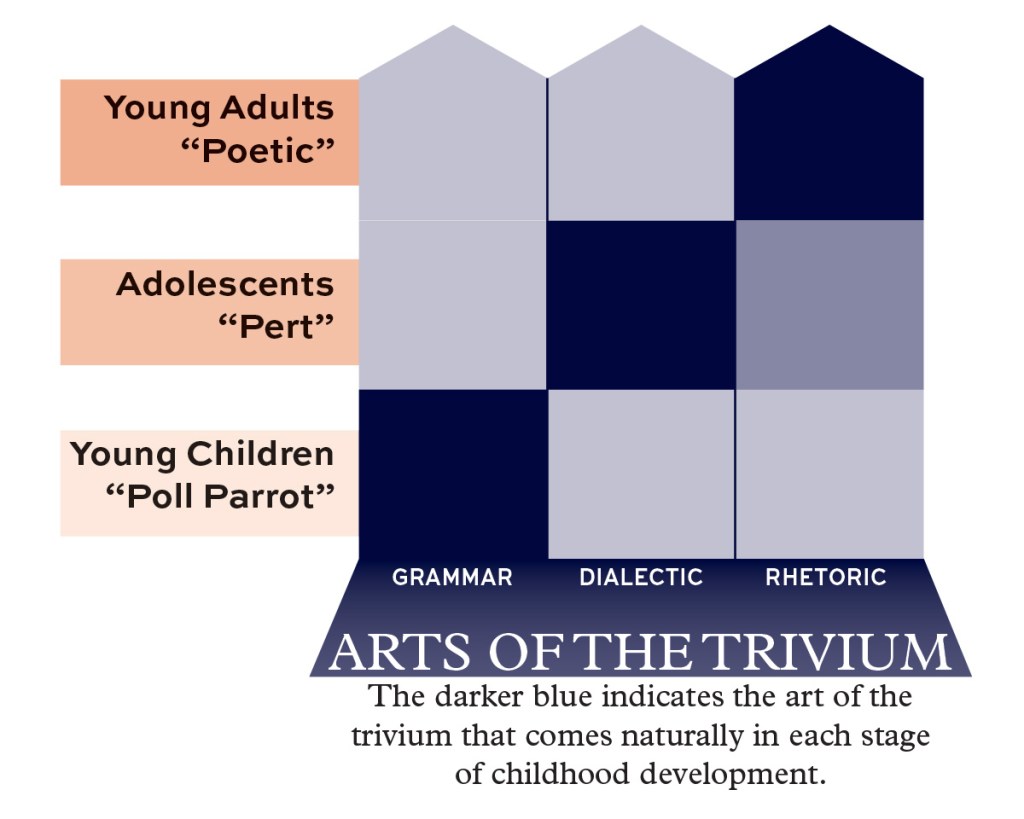
The core of classical education is a three-stage process called the Trivium. The curriculum and teaching methods are tailored to a child’s natural developmental stage, ensuring they are taught what they are ready to master.
- Grammar Stage (Elementary School: Approx. ages 4-11)
- Focusing on knowledge (The What): This stage aligns with a child’s natural love for memorization and repetition. Students absorb facts (the “grammar” or building blocks) in all subjects. In community this is modeled in several different ways – through songs, chants and rote memory work.
- Dialectic/Logic Stage (Middle School: Approx. 12-14)
- This stage focuses on understanding (The Why). As students transition into adolescence, they begin to question and debate. They learn to reason, analyze and logically connect the facts they’ve previously memorized. Students study formal logic, learn to construct solid arguments, detect fallacies and develop critical thinking skills.
- Rhetoric Stage (High School: Approx. 15-18)
- Here we focus on wisdom (The How): Students are naturally interested in self-expression and forming their own opinions. They learn to express themselves persuasively and eloquently (both written and verbally). Our students apply their knowledge and logical skills to articulate their understanding, defend their ideas, and master the art of effective communication.
Are you currently implementing these natural stages in your homeschool journey? Tell us how!
Click here to explore recommended resources for homeschooling classically.
 CC Moorestown
Leave a comment