• About CC Moorestown: Our Classical Homeschooling Community

    Welcome to CC Moorestown! We are a licensed Classical Conversations community serving families in the Moorestown, New Jersey area, who are committed to pursuing a Christ-centered, classical education at home.

    Our community launched just two years ago with a handful of dedicated families, and we have been blessed to witness God’s faithfulness and the joy of learning together since then. Our vision is to continue growing in the coming years, supporting and equipping parents to homeschool through all programs. From our youngest Foundations students through Challenge high schoolers.

    We believe that education is best experienced in community – where parents are encouraged and students find fellowship and accountability.

    Not in Moorestown? No Problem!

    Classical Conversations is a thriving movement across South Jersey and the entire USA! You can easily find the location that is closest to you by using the official CC search tool here.

    Experience Community: Sign Up for an Open House

    The best way to understand Classical Conversations is to see it in action!

    We warmly invite you to sign up for a local open house. This is an opportunity to:

    • Experience community day: Observe our programs in session and see how classical learning unfolds.
    • Meet our families: Connect with experienced homeschool parents and tutors.
    • Ask questions: Get answers about curriculum, weekly rhythm, and community support.

    Click here to find and register for an open house near you! (Be sure to search by your zip code and enter “open house” as the event type.)

    Find more information about the classical education model here!
  • Faith, Family, and Freedom: What We Believe

    Classical Conversations understands that the decision to homeschool is significant. It requires courage, dedication, and support. That is why the organization is built on a foundation that goes far beyond academics. Driven by a singular, overarching purpose: To know God and to make Him known.

    Whether you are new to homeschooling or a seasoned veteran, we want to share the vision that propels our communities forward and the core beliefs that anchor us.

    Our Mission

    Everything we do begins with our mission. We believe that the ultimate purpose of education is to know God and to make Him known.

    This isn’t just a catchy slogan; it is the lens through which we view history, science, math, and language. We believe that wrestling with truth promotes blessing and virtue, not just for the student, but for the whole community.

    Our Vision: How We Walk This Out

    How do we turn that mission into reality? Classical Conversations fulfills its mission by curating curriculum, providing services, and training parents to build flourishing homeschool communities.

    With a team that is committed to both practicing and supporting this journey by:

    • Submitting our own bodies, minds, and spirits to the work of Christ, joining the great classical conversations of history.
    • Supporting licensed homeschooling leaders who imitate Christ’s work of reconciliation by serving families.
    • Encouraging parents to develop the confidence to lead Christ’s natural classroom—the family.
    • Challenging entire families to cultivate the art of wisdom through knowledge and understanding.
    • Developing resources that ensure our families are equipped to conquer any obstacle in their pursuit of Christ.

    What We Believe

    Our model of education is built on trust—specifically, the trust that God has placed in parents. We believe that God trusts parents with their children, and so should we.

    Because education is the responsibility of the family, we believe that parents are the best educators for their children. However, this doesn’t mean you have to do it alone.

    The Power of Community We believe that the support of a like-minded community enhances our ability to fulfill our parental duties. Community provides two essential things:

    1. Support: To lift us up when the journey is hard.
    2. Accountability: To sharpen and humble us as we grow together.

    The Classical Difference Why classical education? It embodies the most natural tools of learning. By using the classical model, we prepare our children (and ourselves) to accept the responsibilities of Christian freedom. We hold that truth is required to inculcate wisdom, knowledge, and understanding.

    Join the Conversation

    We want to see you develop the confidence to lead your family, supported by fellow believers, as you uncover the truth, beauty, and goodness of God’s creation together.

    Are you ready to understand the “why” and “how” behind our curriculum and community even better? Here is a great starting point!

  • Classical Conversations: Your Official Guide to Getting Started

    Ready to dive deeper into the methods and mission of Classical Conversations? Here is a compiled list of essential resources to help you understand the why, the what and the how of CC.

    3 Essential Videos

    The best way to begin is by spending a few minutes watching the official “Start Here” videos. This comprehensive, three-part series will clarify the core concepts of Classical Conversations.

    • Video 1: Why Consider Classical Christian Education?
    • Video 2: What Does Classical Christian Education Mean? (Get a clear definition of the Trivium.)
    • Video 3: How Does a Classical Christian Education Work? (Review practical applications within the CC model.)

    Watch the “Start Here” video series here!

    Explore the bookstore and catalog

    Once you have an understanding of what a classical Christian education looks like, check out the resources in the Classical Conversations bookstore. These cover all CC programs from at home Scribblers, Foundations, Essentials and all Challenge levels.

    Here is the link to the virtual catalog which is filled with great articles and some encouraging and equipping great reads. The following pages are especially helpful:

    • Page 6 – The Classical Trivium
    • Page 12 – Meet the Founder (Leigh Bortins) & the Family
    • Page 21 – Catechesis Wheel
    • Page 25 – What is Classical Conversations?
    • Page 40 – Scope & Sequence Chart (of Curriculum)
    • Page 46 – Foundations (Ages 4-12): Great Education Starts with a Firm Foundation
    • Page 50 – Essentials (Ages 9-12):  Words, Numbers and Sentences Are Essential to Language Development
    • Page 52 – Challenge (Ages 13-18)

    Join the Conversation!

    The heart of Classical Conversations is truly the local community. We encourage you to take one of these final steps to connect directly with a CC in your area:

    1. Attend an Information Meeting – These sessions are usually hosted by an experienced local Director, who will provide a detailed overview of the CC programs, curriculum, and community structure. This will give you a chance to have all your specific questions answered.
    2. Experience Community in action at a local CC community – Visit an open house which allows you and your children to observe classes, meet families and feel the excitement of the classical model being practiced.

    Find a local open house or information meeting here!

  • Unlock Your Homeschool’s Potential: What is Classical Education?

    Classical Education is an approach to learning that focuses on teaching children how to learn (the tools) rather than simply memorizing isolated facts (the content). It’s a time-tested, comprehensive method rooted in a tradition that dates back to ancient Greece and Rome, emphasizing wisdom, virtue and mastery of communication.

    Easy Definition Of The Trivium

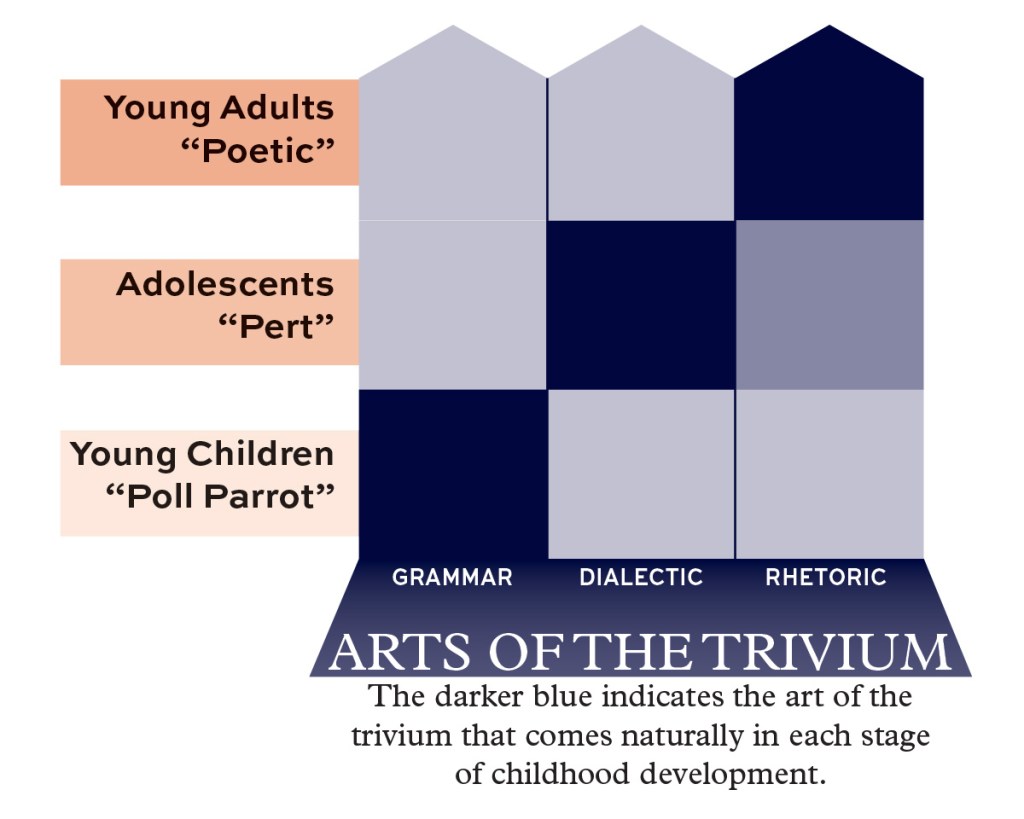
    The core of classical education is a three-stage process called the Trivium. The curriculum and teaching methods are tailored to a child’s natural developmental stage, ensuring they are taught what they are ready to master.

    1. Grammar Stage (Elementary School: Approx. ages 4-11)
      • Focusing on knowledge (The What): This stage aligns with a child’s natural love for memorization and repetition. Students absorb facts (the “grammar” or building blocks) in all subjects. In community this is modeled in several different ways – through songs, chants and rote memory work.
    2. Dialectic/Logic Stage (Middle School: Approx. 12-14)
      • This stage focuses on understanding (The Why). As students transition into adolescence, they begin to question and debate. They learn to reason, analyze and logically connect the facts they’ve previously memorized. Students study formal logic, learn to construct solid arguments, detect fallacies and develop critical thinking skills.
    3. Rhetoric Stage (High School: Approx. 15-18)
      • Here we focus on wisdom (The How): Students are naturally interested in self-expression and forming their own opinions. They learn to express themselves persuasively and eloquently (both written and verbally). Our students apply their knowledge and logical skills to articulate their understanding, defend their ideas, and master the art of effective communication.

    Are you currently implementing these natural stages in your homeschool journey? Tell us how!

    Click here to explore recommended resources for homeschooling classically.

  • The Ultimate Guide to Classical Education Homeschool Resources

    To learn more about classical education and how to implement this powerful model in your homeschool, the following books and articles are highly recommended.

    The Lost Tools of Learning by Dorothy Sayers

    This influential article by a contemporary of C.S. Lewis, discusses the tools to enable the analysis and mastery of every other subject. It’s considered a foundational text for the modern classical education movement. Download a free copy here.

    Classical Education Made Approachable by Classical Conversations

    Are you intimidated at the prospect of building a classical, Christian education for your family? Learn how you too can build your family’s home-centered, classical education using the building blocks of knowledge, understanding, and wisdom.

    Echos in Celebration by Leigh Bortins

    This easy-to-read book promotes classical Christian education and stresses the importance of relationship between teachers and students. It encourages parents to equip their children to become lifelong learners who study all subjects to know God and to make him known.

    The Core by Leigh Bortins

    Describes the rigorous academics that form the core of a solid education. It emphasizes building a strong foundation in the grammar stage so students can advance more competently through higher education. Read more about the grammar stage and Trivium here.

    Refining Rhetoric/ Relatable Podcast with Allie Beth Stuckey

    Discusses building a biblical worldview, how to reasons to opposing opinions, and helping children navigate modern culture through the lens of a classical Christian education. Topics include educational independence, the history of public education, and addressing contemporary cultural issues.

    Everyday Educator Podcast presented by Classical Conversations

    This podcast provides practical tips, encouragement, and actionable advice for successfully implementing a classical, Christian education in your home. Covers topics from managing multiple students, creating family traditions, neurodivergent learners and finding a family groove in homeschool.

    Your Turn:

    • Have you found any of the mentioned materials helpful?
    • What are some resources your family relies on or recommends?

    Drop a comment below—We would love to expand our list with suggestions.